An honest, in-depth look at the sensors, the science, and the real trade-offs — before you decide if it's right for your wrist.
Not a scam — Hume Health is a real, established company with 48,000+ verified customer reviews.
Most fitness trackers tell you how hard you worked out. The Hume Band 2.0 tries to tell you how fast you're aging — and what to do about it. This screenless wearable tracks Metabolic Capacity, Metabolic Momentum, HRV, and blood pressure trends around the clock, then uses AI to turn that data into a daily action plan. No required subscription, no screen to squint at — just five LEDs, four photodiodes, and 14 days of battery between charges. We dug into the sensors, the science, and the honest trade-offs before deciding if it earns a spot on your wrist.
At full price, the Hume Band 2.0 lists at $356 USD, but the official site is currently running it at $249 USD for a single band — with better per-unit pricing on multi-packs. Prices are shown in USD; the official checkout converts to your local currency (GBP, CAD, or AUD) automatically at checkout.
| Package | Price (USD) | Best For |
|---|---|---|
| 1 Band | $249 | Individual use |
| 3 Bands | ~$199/each ($597 total) | Sharing with a partner or family |
| 6 Bands | ~$179/each ($1,074 total) | Households, gifting, long-term stock-up |
* Prices shown in USD, reflecting the offer at time of publishing (July 2026). Your local currency and any applicable duties/VAT are calculated automatically at checkout — always confirm the current price there, as official pricing and bundles may change.
Most competitors in the wearable-health space charge $300–$480/year just to unlock full data access behind a subscription. The Hume Band 2.0 is a one-time purchase — you own your device and your data outright, with an optional Premium tier at $8.99/month for deeper AI coaching.
US buyers can also use HSA/FSA funds at checkout, effectively lowering the after-tax cost. The extended 10-Year Warranty add-on is optional for everyone — not required to use the device safely.
The Hume Band 2.0 is a screenless wrist wearable built around one premise: most people don't discover a health problem until symptoms show up — and by then it's harder to reverse. Instead of counting steps, it reads biomarkers continuously and turns them into a picture of how you're actually aging.
No display, no subscription required for core data, and a flagship focus on longevity metrics — Metabolic Capacity, Metabolic Momentum, and Biological Age trend — alongside familiar stats like resting heart rate and sleep stages. It's currently priced at $249 USD (down from $356 USD), backed by a 45-day return window.
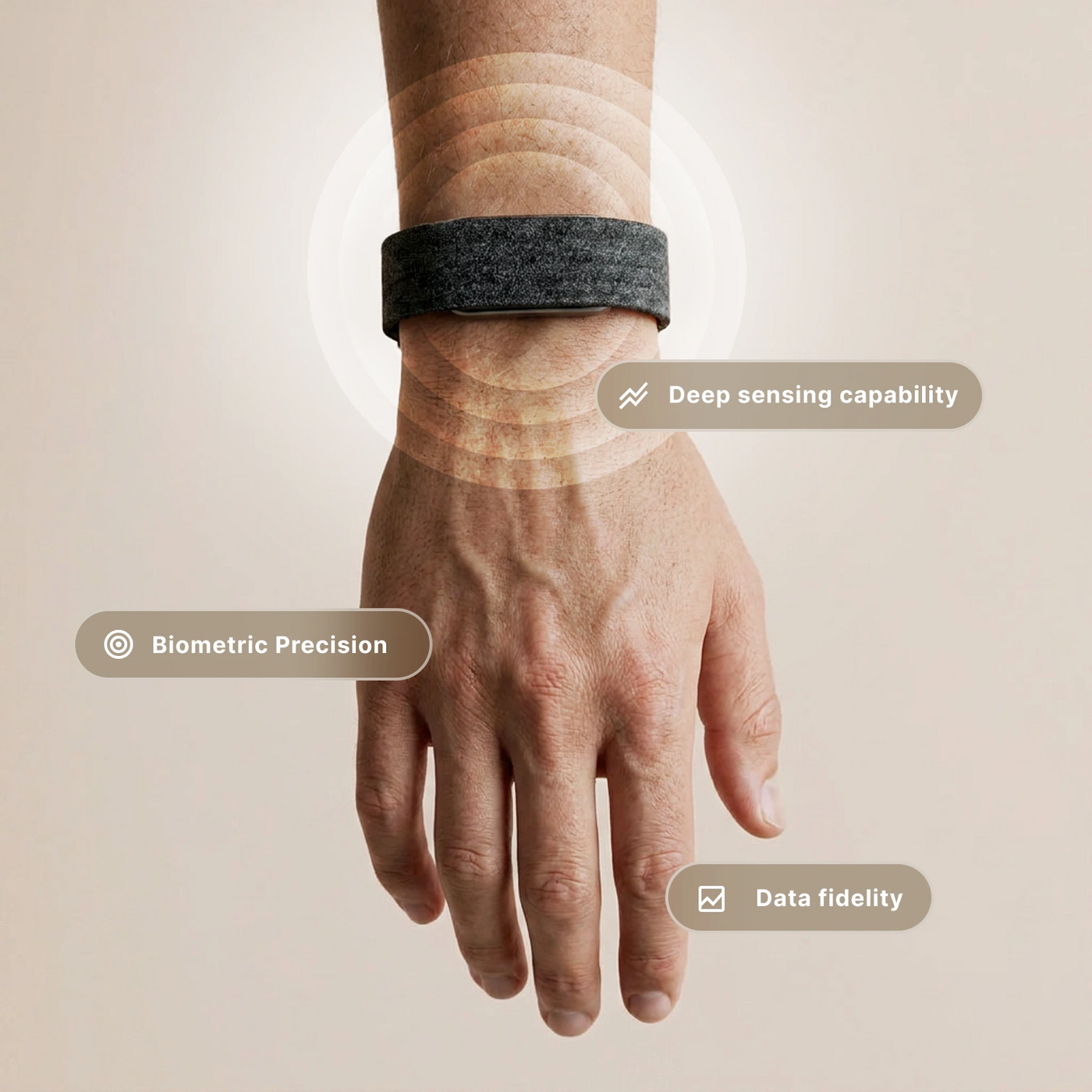
5 LEDs and 4 photodiodes read signals through the skin via photoplethysmography (PPG) — the same core tech in medical pulse oximeters, sampling more often than most consumer wearables.
Raw data streams into the Hume Health app, where algorithms convert it into headline scores: Metabolic Capacity, Metabolic Momentum, and Biological Age / Pace of Aging.
The free tier surfaces raw metrics and trends. Optional Hume Premium ($8.99/mo) layers in AI-guided, personalized recommendations on top.
The intended pattern is "wear it and forget it" — rated for 24/7 wear, including sleep and showering, with the app becoming a once-a-day check-in rather than a constant glance.
For the vast majority of adults, yes — the Band uses low-power optical sensors and passive skin contact. A few groups should check with a doctor first: anyone with a pacemaker or implanted electronic device, individuals with severe photosensitivity, and those with known silicone/strap-material allergies.
It's not a medical device — it hasn't been cleared by the FDA (US), MHRA (UK), Health Canada, or the TGA (Australia) for diagnosis or treatment. Its Biological Age, Metabolic Capacity, and illness-risk indicators are wellness signals meant to prompt a conversation with your doctor, not replace one.
For most healthy adults, daily wear carries no meaningful risk. Data is stated to be encrypted end-to-end and stored on HIPAA-compliant servers, never sold to third parties.
Continuous sleep-stage tracking (light, deep, REM) shows whether your sleep is actually restorative — not just long.
Daily blood pressure trends, resting heart rate, and HRV captured passively — data that traditionally required a clinic visit.
Metabolic Capacity answers a better question than step count: is your body recovered enough to handle today?
Metabolic Momentum tracks whether daily choices compound positively over weeks and months — a visible trend line, not vague advice.
Per Hume Health's own reported user data, a meaningful share of health alerts were later confirmed by a doctor visit.
Core metrics aren't gated behind a required monthly fee — value compounds the longer you own the device.
Note: percentage figures referenced above are self-reported by Hume Health from their own user base, not the result of independent third-party testing.
The no-screen design took a few days to get used to, but now I actually prefer it — I check the app once in the morning instead of glancing at my wrist all day.
I like that I'm not paying a monthly fee just to see my own sleep data. The Metabolic Momentum score is the one I check most — it's a good nudge to stay consistent.
Battery life is the real selling point for me. I charge it maybe twice a month and genuinely forget I'm wearing it — even in the shower.
Blood pressure trends aren't as precise as my home cuff, but as a daily directional check it's genuinely useful — I bring the trend graph to my checkups now.
Representative testimonials synthesized from patterns in publicly available user feedback. Individual results vary.
As the Hume Band 2.0 has grown in popularity, look-alike listings are showing up on Amazon, eBay, and other marketplaces. Devices sold outside the official Hume Health store aren't guaranteed authentic, typically do not honor the 45-day guarantee or hardware warranty, and their data-security practices can't be verified. Since this device continuously reads sensitive biometric data, buying through an unverified reseller means you can't confirm how that data is encrypted or stored. The safest path is checking out directly through the official channel.
A 45-day window is long enough to move past the "new gadget" excitement and actually judge whether the data changes your habits — which is the only fair test for a device like this.
Optional paid upgrades (not included): Hume Premium ($8.99/mo), extended 10-Year Warranty, Hume Pod (sold separately).
After going through the sensors, the science, and the honest limitations: if you want to actually see how your daily choices affect your body — not guess, not wait for a checkup — this is one of the few wearables built specifically for that. You're not paying a monthly fee to access your own data, and you get 45 days to test whether it actually changes anything.
Backed by a 45-day money-back guarantee — try it risk-free.
Overall Score
The Hume Band 2.0 isn't trying to be a smartwatch, and it isn't trying to be a medical device. It's trying to do one thing well — give you a clear, ongoing picture of how your body is holding up, before something forces you to pay attention. The metrics go deeper than step counts, the sensors sample more often than most competitors, and you're not stuck paying a subscription just to see your own numbers. The trade-offs are real too — no screen, directional blood pressure rather than clinical-grade, and full coaching sits behind an optional Premium tier. For anyone thinking seriously about long-term health, it's one of the more substantive options currently available.